Personalized tACS Pipeline#
Working memory difficulties are among the first signs of psychosis, and current medication does little to improve them. Young people with 22q11.2 deletion syndrome are at high risk of psychosis, which makes alternative treatments especially important for them.
In a double-blind, sham-controlled study, transcranial alternating current stimulation (tACS) was applied between frontal and temporal regions during a visual working memory task [1]. Because brains differ from one person to the next, the stimulation parameters were tailored to each participant. I coded the pipeline that turns each participant’s T1 and EEG data into a time course for each region of interest, which is then used to find the stimulation target for the next day.
The pipeline#
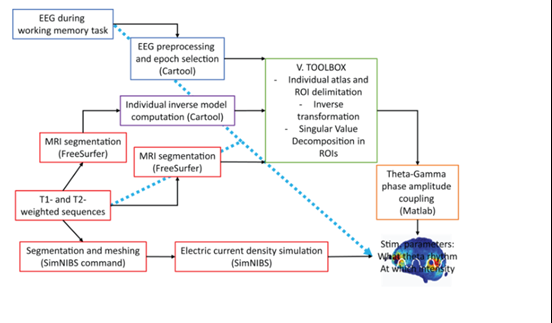
Study analysis pipeline, from the EEG and MRI data to the stimulation parameters.#
Collect the data (Day 1): T1- and T2-weighted MRI sequences, and a high-density EEG recording during a working memory task.
Prepare the EEG: preprocess the recording and select epochs with Cartool.
Build the individual model: segment the MRI with FreeSurfer, then compute the individual inverse model with Cartool.
Extract regional activity: delimit the regions of interest from an individual atlas, apply the inverse transformation, and use singular value decomposition (SVD) to compute a time course for each region.
Find the theta rhythm: compute theta-gamma phase-amplitude coupling in Matlab, between the theta phase in prefrontal regions and the gamma amplitude in temporal regions, to select each participant’s stimulation frequency.
Model the intensity: segment and mesh the MRI, then simulate the electric current density with SimNIBS.
Stimulate (Days 2 and 3): participants receive either tACS or sham stimulation, then complete the visual working memory task and a control task.